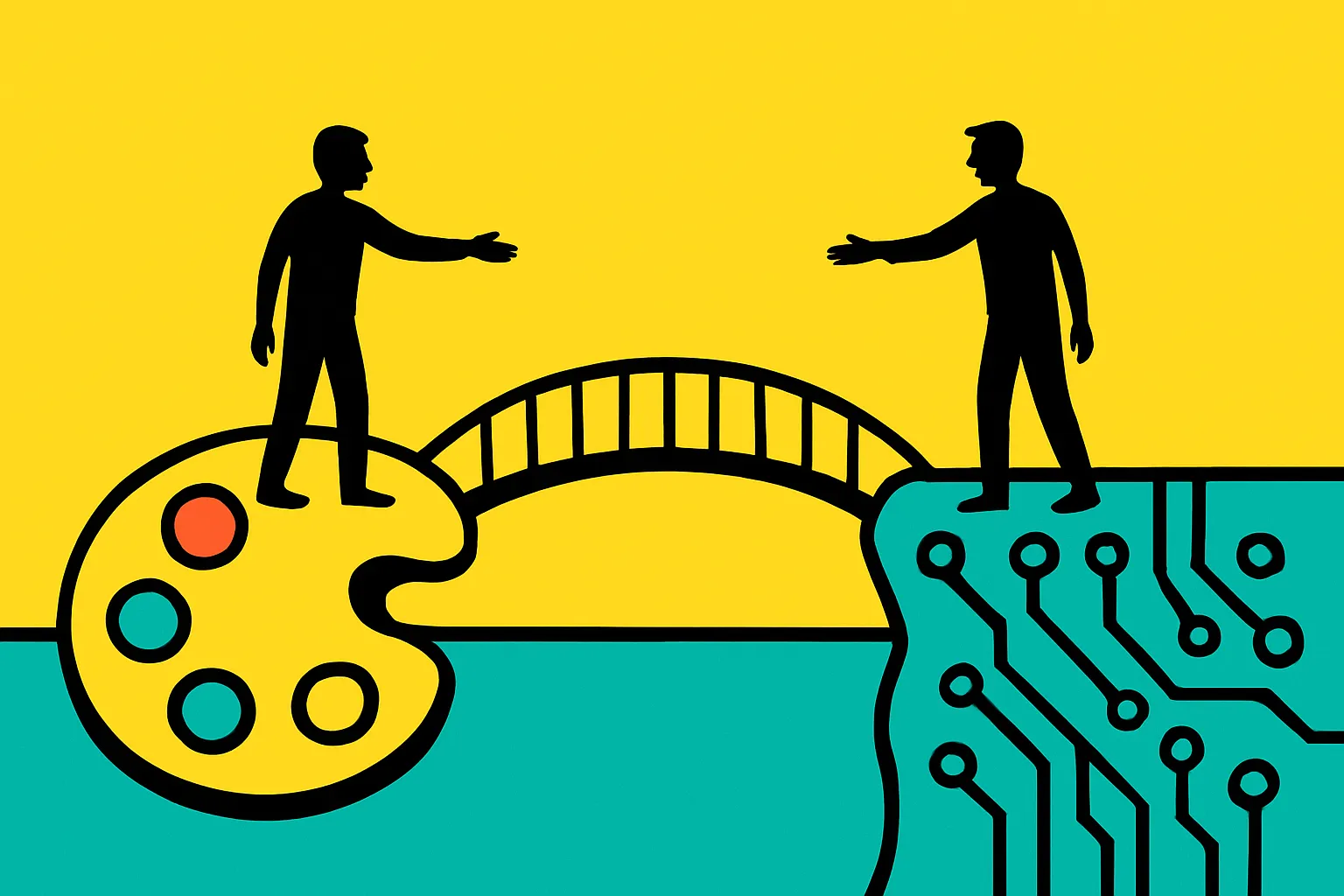
Designer-Developer Collaboration: Building Bridges That Last
The divide between designers and developers is one of the oldest friction points in digital product creation. You've probably experienced it yourself—beautiful mockups that are "impossible to build," or technically sound implementations that somehow miss the mark on user experience. This tension isn't just frustrating; it's expensive. Poor collaboration between design and development teams leads to costly revisions, missed deadlines, and products that underperform in the market.
But here's the thing: designer-developer collaboration doesn't have to be a constant battle. When these two disciplines work in harmony, magic happens. Products ship faster, quality improves, and teams actually enjoy their work. The secret isn't just about tools or processes—it's about building genuine understanding and respect between people who speak different languages but share the same goal.
This article breaks down practical, battle-tested strategies for fostering collaboration between designers and developers. We'll explore how to create shared understanding, establish better communication rhythms, and build team structures that naturally encourage cross-functional partnership. Whether you're a design lead trying to improve handoffs, a developer frustrated with ambiguous requirements, or a product manager caught in the middle, you'll find actionable tactics you can implement immediately.
Quick Takeaways
- Shared language matters: Establishing common terminology and understanding technical constraints early prevents miscommunication and rework
- Early involvement wins: Including developers in design discussions and designers in technical planning creates better solutions from the start
- Joint workshops break down silos: Regular collaborative sessions build empathy and reveal opportunities that isolated teams miss
- Unified goals align efforts: When designers and developers share the same success metrics, natural collaboration follows
- Design systems are collaboration tools: A well-maintained design system serves as a shared source of truth that bridges disciplines
- Async documentation reduces friction: Clear, accessible documentation respects different working styles while maintaining alignment
- Psychological safety enables innovation: Teams that feel safe challenging ideas and admitting constraints produce better outcomes
Why Designer-Developer Collaboration Breaks Down
Before we can fix the problem, we need to understand why collaboration between designers and developers so often fails. The root causes are rarely about individual competence—they're systemic.
Different mental models create the first barrier. Designers typically think in terms of user needs, emotional responses, and visual hierarchies. Developers focus on logic, performance, and maintainability. Neither perspective is wrong, but without translation, they talk past each other.
Misaligned incentives compound the issue. Designers might be measured on creative innovation and user satisfaction scores, while developers are evaluated on code quality and delivery speed. When success looks different for each discipline, you've inadvertently created competing priorities.
Sequential workflows treat design and development as relay race handoffs rather than continuous collaboration. The "throw it over the wall" mentality means developers inherit decisions without context, and designers discover technical constraints too late to adapt elegantly.
Finally, there's simple lack of exposure. Many designers have never written production code. Many developers haven't conducted user research or explored design alternatives. Without understanding what the other discipline actually does daily, empathy remains shallow.
Building a Foundation: Shared Language and Understanding
The most effective collaboration strategy starts before any project kicks off: developing a shared vocabulary that both disciplines understand and use consistently.
Start by creating a glossary of terms that bridges design and development concepts. What designers call "components" might be "modules" to developers. "States" in design thinking map to different code implementations depending on context. Document these translations and reference them in daily work.
Technical literacy for designers doesn't mean every designer needs to code, but understanding basic technical constraints transforms conversations. When designers grasp concepts like responsive breakpoints, API limitations, browser capabilities, and performance implications, they design more realistic solutions. Consider running monthly "tech 101" sessions where developers explain technical concepts in approachable ways.
Similarly, design literacy for developers opens new possibilities. When developers understand design principles like visual hierarchy, accessibility best practices, gestalt theory, and user research methodologies, they make better implementation decisions and spot design inconsistencies earlier.
Create opportunities for job shadowing. Have designers sit with developers during implementation. Let developers observe user research sessions or design critiques. This mutual exposure builds intuitive understanding that no documentation can fully capture.
Involving Both Disciplines from Day One
One of the most impactful shifts you can make is ending the sequential handoff model. When designers and developers engage together from project inception, problems get solved before they become expensive.
Design kickoffs should include developers. Before sketches begin, gather the full team to discuss the problem you're solving, user needs, business constraints, and technical considerations. Developers often raise implementation questions that inspire creative solutions designers wouldn't have explored alone.
Technical feasibility discussions during ideation save enormous time. Instead of designers spending weeks on concepts that can't be built within budget, quick technical consultations can steer exploration toward viable directions—or identify where extra investment is justified for high-impact features.
Pair design sessions bring powerful results. Try having a designer and developer work together on a whiteboard or in Figma, sketching concepts while simultaneously discussing implementation approaches. This real-time dialogue produces solutions that are both user-friendly and technically elegant.
Development previews during design help too. Rather than waiting for "final" designs, developers can begin prototyping with early-stage work, providing feedback that shapes the design direction. This iterative overlap accelerates timelines and improves outcomes.
Joint Workshops That Generate Alignment
Collaborative workshops are powerful tools for breaking down silos and building shared understanding, but only when designed intentionally.
Design system workshops bring designers and developers together to establish or evolve the shared component library. These sessions should tackle questions like: What variants do we actually need? What props should be configurable? How do we name things consistently? Having both disciplines in the room ensures the system works for everyone.
User story mapping sessions help teams visualize the entire user journey together. Designers contribute insights about user needs and pain points, while developers raise questions about data requirements and technical dependencies. The result is a more complete picture than either group would create alone.
Retrospective workshops after major releases create space for honest reflection. What worked? What frustrated us? Where did miscommunication happen? These conversations, facilitated neutrally, help teams identify patterns and commit to specific improvements.
Cross-functional design sprints tackle specific challenges in concentrated bursts. Following frameworks like Google Ventures' design sprint, mixed teams move from problem to prototype to testing in days, building camaraderie and shared ownership along the way.
Establishing Shared Goals and Success Metrics
Nothing aligns teams faster than unified success metrics that everyone works toward together.
Most organizations accidentally create misalignment by measuring designers and developers separately. When designers are evaluated on "design quality" and developers on "code efficiency," you've built competing incentives into your structure.
Instead, define shared outcome metrics that require both disciplines to succeed. These might include user satisfaction scores, feature adoption rates, page performance metrics, accessibility compliance percentages, or time-to-market for new features. When designers and developers win or lose together, collaboration becomes natural rather than forced.
Make metrics visible through shared dashboards that everyone checks regularly. When the whole team sees how real users interact with their work—where they struggle, what delights them, what performs poorly—conversations shift from theoretical debates to problem-solving.
Celebrate wins together and own failures collectively. When a feature succeeds, credit the team, not individuals. When something flops, retrospect as a group without finger-pointing. This psychological safety encourages people to take collaborative risks.
Design Systems as Collaboration Infrastructure
A well-maintained design system is perhaps the most powerful collaboration tool available, serving as a single source of truth that both designers and developers reference.
Co-ownership of the design system ensures it serves both disciplines. Designers shouldn't define components in isolation, nor should developers make implementation decisions without design input. Establish a governance model where both groups approve changes.
Living documentation that includes design guidelines alongside code examples helps everyone stay aligned. When designers see exactly how a component behaves in code, and developers see the design principles behind decisions, the system becomes self-explanatory.
Component contribution processes should be straightforward enough that both designers and developers can propose additions or modifications. Create templates and checklists that guide contributions through design specs, accessibility requirements, responsive behavior, and code implementation.
Regular design system reviews bring stakeholders together to assess what's working and what needs evolution. These sessions prevent the system from becoming stale or diverging between design files and production code.
Creating Cross-Disciplinary Team Structures
How you organize teams fundamentally shapes collaboration patterns. Cross-functional team structures that include both designers and developers working toward shared goals consistently outperform siloed departmental structures.
Product squads organized around features or user journeys rather than disciplines create natural collaboration. When a squad owns the complete shopping cart experience, for example, the designer and developers work intimately together because they share responsibility for outcomes.
Embedded designers who work directly within development teams rather than in separate design departments build stronger relationships. Daily proximity—whether physical or virtual—increases informal communication and mutual understanding.
Rotating partnerships can prevent knowledge silos. Rather than always pairing the same designer with the same developer, periodically rotate partnerships so everyone gains broader perspective and relationships multiply across the organization.
Design-development liaisons work well in larger organizations. Designate specific individuals as bridges between disciplines—developers who have design interest or designers with technical backgrounds. These people naturally translate between worlds and can mentor others in building cross-disciplinary skills.
Communication Rhythms and Rituals
Establishing consistent communication patterns prevents misunderstandings and keeps everyone aligned without excessive meetings.
Daily standups that include both disciplines ensure everyone knows what's in progress and where help is needed. Keep them brief—15 minutes maximum—and focused on coordination rather than detailed problem-solving.
Design review sessions with developer participation yield better outcomes. Developers attending design critiques can ask clarifying questions, surface technical considerations, and begin forming mental models for implementation. This prevents "surprises" during development.
Development demos that designers attend close the feedback loop. When designers see their work come to life in code, they can spot discrepancies early and provide real-time guidance. They also learn what's technically feasible, informing future designs.
Asynchronous documentation practices respect different working styles and time zones. Not everything requires a meeting. Clear written specifications, well-commented design files, recorded video walkthroughs, and annotated prototypes let people consume information when it fits their workflow.
Tooling and Workflow Optimization
The right collaboration tools reduce friction and keep everyone working from the same foundation.
Shared design tools that developers can access directly eliminate handoff ambiguity. Tools like Figma, which developers can inspect for measurements, colors, and assets, reduce back-and-forth questions and ensure accuracy.
Version control integration helps tremendously. When design files live in systems with version history and commenting (like Abstract or Git-based solutions), tracking changes and discussing decisions becomes straightforward for both disciplines.
Collaborative prototyping tools that allow code-based prototypes or design-to-code handoffs (like Framer, Webflow, or component-based design tools) let teams explore interactions with production-quality fidelity. Developers see exactly how animations should behave, and designers understand technical possibilities.
Integrated project management ensures everyone works from the same task list and roadmap. When designers and developers use the same system to track work, dependencies become visible and planning becomes collaborative.
Handling Disagreements Constructively
Even with perfect processes, conflicts between design and development perspectives will arise. How you handle these moments determines whether collaboration strengthens or fractures.
Assume positive intent as the foundational principle. When a developer says a design is "impossible," they're likely highlighting a real constraint, not dismissing creativity. When a designer resists a "simpler" solution, they're probably protecting a user need, not being difficult.
Make the problem visible to both sides. Use shared prototypes, user research data, or technical diagrams to move from abstract debate to concrete problem-solving. Often disagreements evaporate when everyone examines the same evidence.
Explore alternatives together rather than defending initial positions. "Yes, and…" improvisation techniques work beautifully: acknowledge the constraint or requirement the other person raised, then build on it. This collaborative exploration often yields solutions neither party would have found alone.
Escalate rarely, but effectively. When disagreements genuinely can't be resolved through discussion, involve a neutral third party—product manager, team lead, or UX researcher—who can help weigh tradeoffs against user needs and business goals.
Measuring Collaboration Success
You can't improve what you don't measure. Tracking collaboration health helps you identify what's working and where to invest improvement energy.
Quantitative indicators might include cycle time from design start to development completion, number of revision rounds required, defect rates related to design-development mismatches, or deployment frequency. Improvements in these metrics often correlate with better collaboration.
Qualitative feedback matters just as much. Regular pulse surveys asking team members about collaboration quality, psychological safety, and cross-functional relationships reveal the human side of teamwork that numbers miss.
Design-development gap analysis examines discrepancies between design intent and shipped product. When gaps are minimal, collaboration is working. When they're significant, dig into root causes—unclear specs, unrealistic constraints, or communication breakdowns.
Team happiness and retention ultimately reflect collaboration health. Teams that work well together stick around. High turnover or persistent complaints about "designers who don't understand development" or "developers who don't care about design" signal systemic problems needing attention.
Conclusion: Building Bridges Worth Crossing
Effective collaboration between designers and developers isn't a nice-to-have—it's a competitive advantage. Companies that crack this code ship better products faster, with teams that actually enjoy the work. The strategies outlined here—shared language, early involvement, joint workshops, unified goals, and intentional team structures—aren't theoretical ideals. They're practical approaches used by teams building products you use daily.
The path forward starts with small steps. You don't need to implement everything simultaneously. Pick one or two strategies that resonate with your team's specific pain points. Maybe that's inviting developers to your next design critique, or asking designers to pair with you during implementation. Maybe it's finally building that design system you've been discussing, or restructuring your team around outcomes rather than disciplines.
Remember, improving collaboration is itself a collaborative effort. Talk with your cross-functional partners about what's not working and what you want to try differently. The very act of having that conversation begins building the bridges you need.
Ready to transform how your design and development teams work together? Start by scheduling a retrospective with your cross-functional team this week. Ask one simple question: "What's one thing we could do to collaborate more effectively?" Then actually implement what they suggest. That's how lasting change begins.
Frequently Asked Questions
How do you handle situations where design and development timelines don't align?
The best approach is preventing misalignment through joint planning. Include both disciplines in estimation and roadmapping so timelines reflect reality from the start. When misalignment happens despite planning, prioritize transparent communication about constraints and explore scope adjustments together rather than unilaterally cutting features or rushing implementation.
What if developers don't have time to attend design workshops or reviews?
This signals a deeper prioritization issue. If collaboration truly matters to your organization, time must be allocated for it in sprint planning and capacity calculations. Start small—even 30 minutes weekly for joint reviews creates value. Record sessions for those who can't attend live, and rotate attendance so everyone participates occasionally without overwhelming individual schedules.
How technical should designers really be? Should they learn to code?
Designers don't need to become proficient developers, but understanding technical fundamentals dramatically improves collaboration. Focus on concepts rather than syntax: how responsive design works, what APIs do, performance implications of design decisions, and browser capabilities. Even a basic HTML/CSS understanding helps designers appreciate implementation complexity and communicate more effectively.
What's the best way to document design decisions for developers?
Combine multiple formats: annotated design files with measurements and states, written specifications explaining the "why" behind decisions, recorded video walkthroughs for complex interactions, and linked user research that justifies design choices. Different developers consume information differently, so redundancy across formats ensures clarity. Most importantly, make documentation easily accessible and searchable.
How do you measure whether collaboration is actually improving?
Track both quantitative metrics (cycle time, revision rounds, defect rates) and qualitative feedback (regular team surveys about collaboration satisfaction). Also monitor proxy indicators like whether designers and developers voluntarily seek each other's input, whether design-development questions are asked earlier in projects, and whether shipped products match design intent more closely over time. Improvement shows up in both hard data and team sentiment.